Key takeaways.
An eyeglass prescription isn’t the same as a contact lens prescription and they aren’t interchangeable.
The primary difference is Vertex Distance—the gap between your eyes and the eyeglass lens, which requires a change in lens power for prescriptions stronger than +/- 4.00 diopters.
Contact lens prescriptions include specific measurements not found on glasses prescriptions, such as Base Curve (BC) and Diameter (DIA), which are essential for a safe fit.
You cannot convert your own prescription. A professional contact lens exam and fitting are required by law to obtain a valid contact lens prescription.
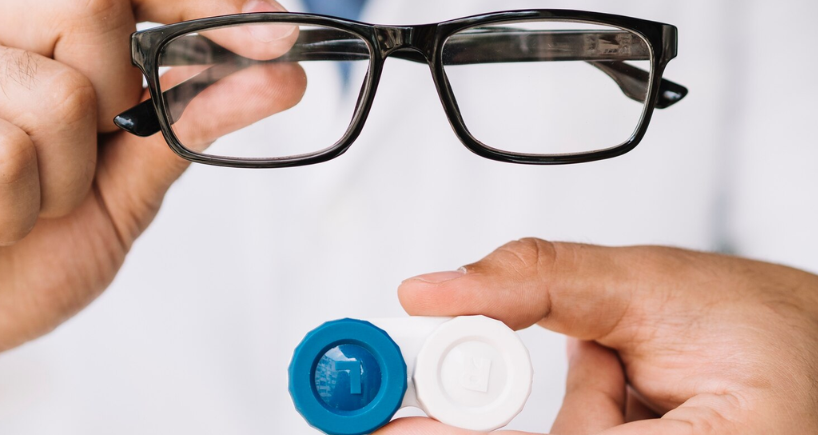
Have you ever wondered: is a contact prescription the same as one for glasses? Can you use your glasses prescription to buy contact lenses? The answer is no, they aren’t the same and you can’t use your glasses prescription to buy contact lenses, and vice versa. While both correct your vision, they are fundamentally different. Understanding the glasses prescription vs contact lens prescription formats is critical for your eye health and vision clarity. This guide breaks down the essential differences and explains why a separate examination for each is non-negotiable.
Why you need two different prescriptions.
The main reason you need two prescriptions is vertex distance. This is the measured distance between the back surface of an eyeglass lens and the front of your cornea.
Eyeglasses sit about 12-14 millimeters away from your eyes.
Contact lenses rest directly on the surface of your cornea (zero distance).
This gap changes the effective power of the lens. For prescriptions with a sphere power stronger than +/- 4.00 diopters, an eye doctor must perform a calculation called vertex compensation to determine the correct power for a contact lens. Without this adjustment, your vision won’t be accurately corrected.
The specifics: what’s different on the prescription?
A contact lens prescription contains several fields of information that are absent from a glasses prescription. To learn more about the terms on a glasses script, see our guide on how to read an eyeglass prescription.
Why base curve and diameter are non-negotiable.
Base Curve (BC) and Diameter (DIA) are crucial measurements for the health and comfort of your eyes. Think of them like the size and width of a shoe; a poor fit causes problems.
Base Curve (BC): Measured in millimeters, this defines the curvature of the back of the contact lens. It’s designed to align with the shape of your cornea.
Diameter (DIA): Also in millimeters, this is the width of the lens from edge to edge. It ensures the lens is large enough to cover your cornea.
An improper fit can lead to serious health issues. A lens that’s too tight can restrict oxygen flow, while a lens that’s too loose can move excessively, causing irritation and blurred vision.
The added complexity of astigmatism (toric lenses).
If you have astigmatism, your cornea is shaped more like a football than a basketball. This requires a special type of contact lens called a toric lens. These lenses have different powers in different meridians and are weighted to keep them from rotating on your eye. A professional fitting is the only way to determine the correct toric lens and ensure it remains stable for clear vision.
Online conversion calculators: what they are and aren’t.
Many people search for how to convert glasses prescription to contacts and find online calculators. While these tools can perform the basic vertex compensation math for a spherical prescription, they’re dangerously incomplete.
An online calculator cannot:
Measure your Base Curve or Diameter.
Assess your tear film and eye health to see if you’re a suitable candidate for contacts.
Determine the correct fit for complex toric or multifocal lenses.
Conclusion: two distinct needs, two separate prescriptions.
The answer to “is contact prescription same as glasses?” is a definitive no. The differences in vertex distance, the need for precise Base Curve and Diameter measurements, and the status of contacts as regulated medical devices all require a separate, professional fitting. Always consult your eye doctor for an accurate prescription for both your contacts and your prescription glasses.